

Balkan Genetics
Parsing the politics to look for scraps of useful information.


I am critical of population genetics for its leftist bias and implications – typically emphasized for Europe – of histories of migration and admixture to justify current population influxes (actually, there is no direct logical connection between descriptive past hstory and today’s prescriptive policies).
I will briefly take a look at this paper. In all cases, emphasis is added.
Summary:
The rise and fall of the Roman Empire was a socio-political process with enormous ramifications for human history. The Middle Danube was a crucial frontier and a crossroads for population and cultural movement. Here we present genome-wide data from 136 Balkan individuals dated to the 1st millennium CE. Despite extensive militarization and cultural influence, we find little ancestry contribution from peoples of Italic descent. However, we trace a large-scale influx of people of Anatolian ancestry during the Imperial period. Between ~250-550 CE, we detect migrants with ancestry from Central/Northern Europe and the steppe, confirming that “barbarian” migrations were propelled by ethnically diverse confederations. Following the end of Roman control, we detect the large-scale arrival of individuals who were genetically similar to modern Eastern European Slavic-speaking populations, who contributed 30-60% of the ancestry of Balkan people, representing one of the largest permanent demographic changes anywhere in Europe during the Migration Period.
Main text:
In late antiquity, the region experienced numerous invading groups labelled by historical sources as Goths, Huns, Gepids, Avars, Heruls, Lombards, or Slavs…
Der Right’s interpretation for all types of migrations and invasions – except for their favorite ethnies of course – is that all heavily contributed to modern genomes, which is not necessarily true.
…the arrival of the Slavs, whose migration to the region was, much like the arrival of Germanic groups in post-Roman Britain, significant enough to have a particularly lasting impact, reflected in the south Slavic languages widely spoken in the Balkans today. Slavic-associated ancestry in present-day populations has been identified as far as the Peloponnese (the southern tip of the Balkan Peninsula in present-day Greece), but the degree, timing and character of permanent demographic impacts across the region have been poorly understood.
“Poorly understood.” Sharp minded alert people begin to see the problem. There has been in fact many previous papers on Slavic genetics. Every time a new population genetics paper comes out – or at least when Der Right likes the data because the data seem to confirm biased preconceptions – it is “the last word” and heavy breathing and endless X posts commence. And along comes another paper, like this one, that takes all of that previous data and bins it together as “poorly understood.” No doubt future papers will come along similarly asserting the importance of new data – including putting the present data of today in the “poorly understood” category – and a new round of heavy breathing will commence.
In fact, archaeogenetic studies are starting to confirm the hints preserved in the documentary record of the empire’s remarkable capacity to foster mobility and mixture.
Alas for the obsessives, not only in Italy.
For instance, a man from Roman York in northern England (ancient Eboracum) showed affinities to modern Middle East populations…
Say it ain’t so!
…and individuals with a high proportion of North African ancestry were found in southern Iberia.
Italian-hating Iberians take note.
A study of 48 skeletons from Rome’s hinterland in the Imperial period showed that at the height of the Empire, genetic ancestry became much more heterogeneous than in previous periods and shifted towards Near Eastern populations and a similarly dramatic shift was shown to extend deep into central Italy.
Heavy breathing leading to hyperventilation commences. These data include the oft-discussed and debated Antonio et al. 2019 paper, the work on Etruscans that Italianthro and others have refuted as regards interpretations, and another paper extending Antonio et al. to a rural site. In other words, this has already been dissected in detail. The “shift” included Greeks as well as genuine Near Easterners and much of it was not permanent. This is an important point that of course applies equally to the Balkans, Roman York, southern Iberia, or wherever – just because X% “diverse” samples were found in an area, say, 2000 years ago, that does not mean that the current population from that area is also X% derived from those diverse sources.
Thus, one reason for stable population structure in Europe since the Iron age despite mobility and migration is because a large fraction of the demographic shirts were temporary and thus not permanent. We will see for the Balkans that the present-day Anatolian admixture is significantly less than the peak percentage of ancient samples genotyped as being Anatolian. The Slavic migrations had a large impact lasting to today, but the Slavs were not so extremely genetically divergent from the original population as to radically alter population structure in the sense meant by sweaty fetishists.
The maintenance of the same geographical pattern along PC1 in both clines points to some degree of local continuity from the Iron Age across the entire region, along with the strong impact of migration from outside the Balkans, affecting all groups from North to South over the past 2,000 years. Irrespective of modern nation-state boundaries, populations in our study area have been shaped by similar processes of migration and change.
Both the Left (including population geneticists) and the Right tend to downplay continuity (with the exception of that population structure paper cited above that, to be fair, came from the academic Left while being mostly ignored by the crazed Right) and over-emphasize migration and change.
Despite the exceptional number of Roman colonies in the region, and the large military presence along this frontier, there is little ancestry contribution from populations long established in the Italian Peninsula, a pattern exemplified by the almost complete absence in our Balkan transect of Y-chromosome lineage R1b-U152, the most common paternal lineage in Bronze Age and Iron Age populations in the Italian Peninsula15,16,29. The prevalence of cremation burials in the earliest centuries could bias the sample, but even after the transition to inhumation burial around the 2nd century, ancestry contributions from populations of Italian descent are not detectable. Rome’s cultural impact on the Middle Danube was deep, but our findings suggest that it was not accompanied by large-scale population movement from the metropole, at least by the descendants of central Italian Iron Age populations.
Cultural but not genetic impacts from Italics.
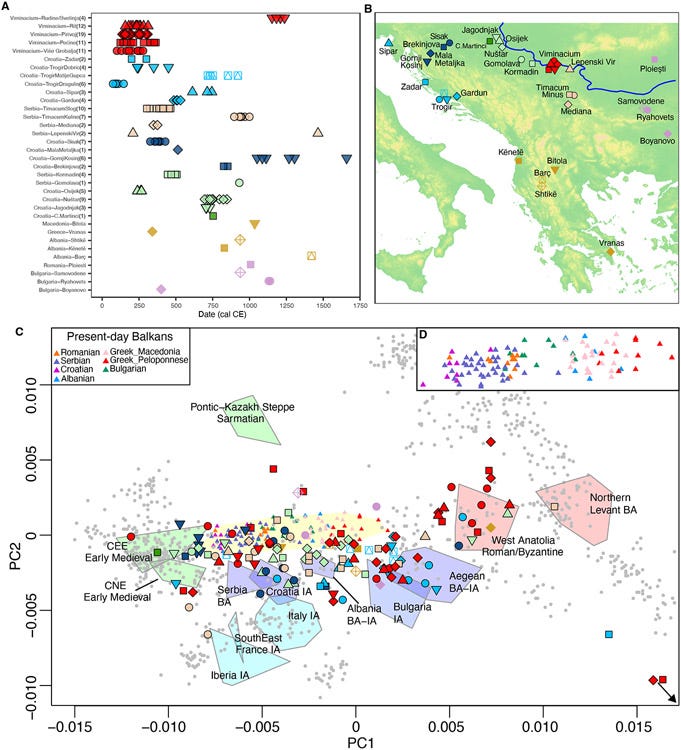
The Roman Empire did, however, stimulate demographic change in the Balkans. In this early period, ~1/3 of the individuals (15 out of 45) fall beyond the Balkan clines in PCA (Figure 1C; Figure S4) but close to Near Easterners, and can be modeled as deriving their ancestry predominantly from Roman/Byzantine populations from Western Anatolia and, in one case, from Northern Levantine groups (Figure 2A; Data S2, Table 6). Most of these individuals were excavated at four different Viminacium necropolises, but we also found them at other urban centers such as Tragurium (Trogir) and Iader (Zadar).
Balkanoids who attack Italians over Imperial Roman migration into Italy take note.
A very strong demographic shift towards Anatolia is also evident in Rome and central Italy during the same period…
The papers cited here are the Antonio et al. 2019 work whose findings and interpretations have already been discussed and debated as well as a Lazaridis (alarm bells!) et al. paper that contains the following interesting tidbit:
The ancestry of the Yamnaya was, by contrast, only partly local; half of it was West Asian, from both the Caucasus and the more southern Anatolian-Levantine continuum. Migration into the steppe started by about 7000 years ago, making the later expansion of the Yamnaya into the Caucasus a return to the homeland of about half their ancestors.
Of course, North Eurasian ancestry also contributed to the Yamnaya.
Thus, Der Right’s beloved Yamnaya was not only heavily West Asian but as other sources indicate partly North Eurasian. They were hardly the Nordic-Aryan-European specimens of rightist fantasy. The point being is that ancestry from “West Asian, from both the Caucasus and the more southern Anatolian-Levantine continuum” is part of European genetics, to different degrees, and cherry-picking data points and (sometimes misleading and/or politically motivated) talking points from academic papers to contrast “pure” Eloi from “mongrel” Morlocks is a gross over-simplification of the complex genetic-historical realities. The same types of ancestry that the fetishists decry in groups they hate also make up part of their own ancestry, even if it may be of an earlier racial-historical provenance.
Back to the Balkans paper:
…and demonstrates long-distance mobility plausibly originating from the major eastern urban centers of the Empire such as Ephesus, Corinth, or Byzantium/Constantinople…
Some of these were likely Greeks (putting aside some of their interpretations of the PCA data).
…our results show that these migrants had a major demographic impact not only on the Imperial capital but also on other large towns on the Empire’s northern periphery.
Define “major.” And was it permanent to the same extent?
The main source of migrants to the region shifted away from Anatolia after ~300 CE (Figure 2A), but together with the ancestral legacy of local Balkan Iron Age groups, Anatolian-related ancestry persisted in admixed form into the later Medieval individuals (Figure 2A) with a mean of 23% (95% CI = 17-29%), indicating that this was a deep and lasting demographic impact.
They do not say of course that the percentage decreased sharply by 1500 CE. Why? You figure it out.
Migrants from sub-Saharan Africa and North Africa
Our newly reported data also revealed sporadic long-distance mobility. Three men who likely lived in the 2nd or 3rd centuries CE fell outside European and Near Eastern variability (Figure S1), close to present-day and ancient Africans (Figure S2A). Proximal qpAdm modeling confirmed these observations (Figure 2A; Data S2, Table 6) with 33% and 100% North African ancestry for individuals I26775 (Iader) and I32304 (Viminacium Pećine), respectively, while I15499 (Viminacium Pirivoj) could be modeled using only ancient East African populations, supporting an East African ancestral origin and agreeing with his uniparental markers mtDNA L2a1j and Y-chromosome E1b-V32, both common in East Africa today. The individual of East African ancestry was buried with an oil lamp depicting Jupiter-related eagle iconography (Figure 2C; Data S1, section 1), not a common finding in Viminacium graves. Isotopic analysis of tooth roots showed that he was also an outlier with respect to dietary habits during childhood (Figure 2B), with elevated δ15N and δ13C values indicating the likely consumption of marine protein sources, unlike individuals from Pirivoj and other necropolises whose values (Figure 2B) were similar to the Roman-Period population from Sirmium and consistent with a largely C3-based diet with a significant portion of animal protein consumption. Thus, he likely spent his early years elsewhere, possibly in East Africa, the land of his ancestors; while we will never know his whole life story, whether as soldier, slave, merchant, or migrant, it encompassed a long journey that ended with his death in adolescence on the northern frontiers of the Roman Empire.
Small numbers of individuals.
From internal to external migration during Late Antiquity
Beginning in the 3rd or 4th century CE, we observe individuals who are admixed with ancestry related to Central/Northern Europeans and Pontic-Kazakh Steppe populations (Figure 4A; Data S2, Table 6). These two ancestry types tend to colocalize in the same individuals, suggesting that the stream of migrants into the Balkans included people who were admixtures of these two sources…
…The appearance of individuals with admixed Central/Northern European and Pontic-Kazakh steppe ancestry inside the Roman Empire in late antiquity reflects the Roman encounter with various trans-frontier populations in this period. Notably, many individuals reflect a prior process of population admixture between these two sources that likely occurred beyond the Roman frontier, perhaps indicative of, e.g., the formation of diverse confederations under Gothic leadership
By the standards of Der Right this means that modern Central/Northern Europeans are admixed with Pontic-Kazakh Steppe populations. Goose and gander – please be consistently ludicrous.
While this absence could reflect unknown sampling bias, it suggests that the population size of incoming Central/North European groups may have been limited as compared to the local Iron Age population, and/or that selective demographic processes—out-migration, differential mortality due to urbanism or military service—acted to prevent a long-lasting demographic impact of these groups.
What do they mean by “long-lasting?”
Slavic migrations and the formation of the present-day Balkan gene pool
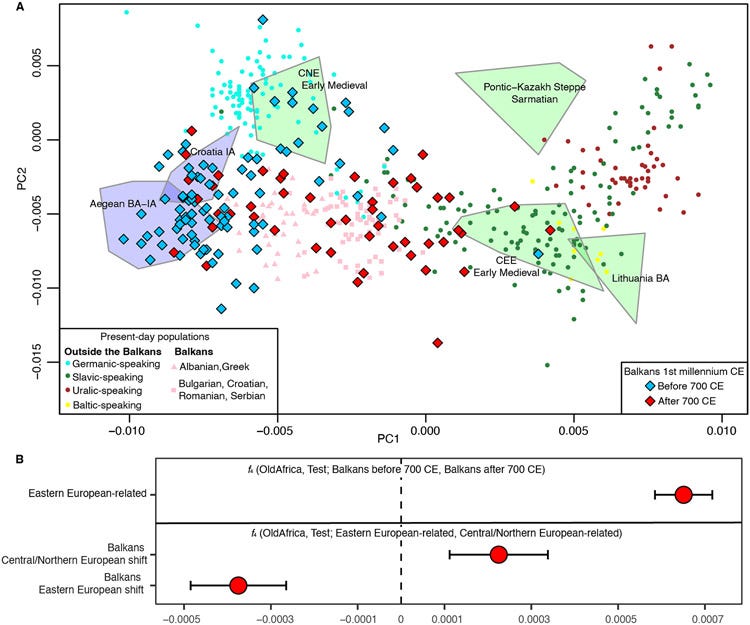
By 700 CE, a new type of ancestry appears across all the Balkan regions covered by our sampling. In a PCA projection onto diverse West Eurasian populations (Figure 1C), these individuals fall at similar positions as the earlier group with Central/Northern European and Pontic-Kazakh steppe-related ancestry. However, we can distinguish their ancestry with a PCA setup more sensitive to recent drift separating Central/Northern and Eastern European populations (Figure 3A). Several Balkan individuals before 700 CE plot close to present-day Central and Northern European Germanic-speaking populations, overlapping individuals from Langobard-associated cemeteries in Hungary and Northern Italy18 displaying Central/Northern European-related ancestry (CNE_EarlyMedieval). After 700 CE, we observe a clear shift toward present-day Eastern European Slavic-speaking populations in the ancient Balkan transect, a shift mirrored by present-day Balkan populations (Figure 3A). Accordingly, Eastern European-related populations share more alleles (Z = 9.85) with Balkan individuals after 700 CE as compared to before 700 CE (Figure 3B). The differential affinities of Balkan individuals with the strongest Central/Northern European shift in PCA (Z = 1.99) and Balkan individuals with the strongest Eastern European shift in PCA (Z = −3.41), is evident using f4-statistics of the form f4 (OldAfrica, Test; Eastern European-related, Central/Northern European-related) (Figure 3B). Corroborating these results, qpAdm models (Data S1, section 4) with Central/Northern European and Pontic-Kazakh steppe groups yield a very poor fit (p = 2.70 × 10⁻¹⁵; Data S2, Table 7) for the group of Balkan individuals with the strongest Eastern European shift, and we were able to obtain a better fit with variable proportions of Balkan Iron Age-related, Anatolian-related and Eastern European-related ancestry (p = 0.049; Data S2, Table 7). As an Eastern European-related proxy, we used a group of early medieval individuals excavated in western Hungary, the Czech Republic, eastern Austria and Western Slovakia (CEE_EarlyMedieval). This group fell within the variation of present-day Eastern European Slavic-speaking populations, very close to the Balkan individuals in our dataset with the strongest Eastern European-related shift (Figure 3A; Figure S3).
Modeling. Modeling, modeling…
We present evidence that Eastern European ancestry was sporadically present in the Balkans long before the Slavic migrations of late antiquity. Indeed, a woman who probably died in the 2nd or 3rd centuries CE and was buried at Više Grobalja presents unmixed Eastern European ancestry (Figure 4A), offering a remarkable illustration of how small-scale individual percolation into the dynamic economy of the Roman Empire may have preceded larger-scale migration.
First, the small-scale migration probing, then then main influx.
To explore whether the Eastern European ancestry signal persisted in present-day Balkan and Aegean populations, we attempted to model present-day groups (Data S1, section 5) by using the same qpAdm model used for the ancient individuals after 700 CE with Eastern European-related ancestry. Present-day Serbs, Croats, Bulgarians and Romanians yielded a similar ancestral composition as ancient individuals after 900 CE at sites such as Timacum Minus, Tragurium or Rudine necropolis at Viminacium, with ~50-60% Eastern European-related ancestry admixed with ancestry related to Iron Age Balkan populations and in some cases also a Roman Anatolian contribution (Figure 4B; Data S2, Table 8), implying substantial population continuity in the region over the last 1,000 years. The Eastern European signal significantly decreases in more southern modern groups but it is still present in populations from mainland Greece (~30-40%) and even the Aegean islands (4-20%). This confirms the observations from PCA (Figure 1C and 3A) and previous genetic studies suggesting a substantial demographic impact in the southern Balkan Peninsula and the Aegean
Roughly speaking, Balkan Slavs as well as Romanians are about half derived from those Slavic migrants with the other half being from pre-existing Balkan populations, with a bit of Anatolian in some cases (but not to the extent of the Anatolian maximum). Greeks have less Slavic influx but do have a significant fraction (suggesting that Southern Italians, including Sicilians, are at least as good if not better representatives of Ancient Greek genetics).
Broadly, our results suggest three phases in the population history of this region in the 1st millennium. First, the high Roman Empire (ca. 1-250 CE) saw the strong impact of Roman culture on the local Iron Age Balkan population. While this process was accompanied by little detectible contribution from populations with ancestry from the Italian Peninsula, there was significant migration by individuals of Anatolian/Eastern Mediterranean ancestry, either directly or through Italy, whose admixture would leave a long trail in later local populations.
“Long trail” – it seems that the “trail” petered out at some point, hmmm?
Meanwhile, militarization and/or economic vitality attracted migrants from further afield both within and beyond the Roman Empire. In some cases at least, the small-scale percolation of individuals preceded large-scale population movements of later centuries.
In the late Roman Imperial period (ca. 250-550) internal migration from within the empire lessened, while the presence of individuals with ancestry originating in populations from beyond the Danube frontier is evident. Admixture was pervasive both among groups originating beyond the frontier (notably Northern/Central Europeans and Pontic-Kazakh Steppe groups) as well as among these groups and the local population.
Goose and gander. Northern/Central Europeans must be partly Pontic-Kazakh by Der Right’s “any migration and admixture in the past has to be perfectly represented in modern populations” standard.
For generations, scholars of late Antique history have debated the extent to which the political transitions accompanying the end of Roman rule were fueled by demographic changes and whether these transitions were driven by ethnogenesis or mass migration. Our findings support a nuanced view in which both ethnogenesis and migration were important.
The “nuanced” view is misleading, such as how they present the Anatolian data.
We document a clear signal of Eastern European-related gene flow in the vast majority of individuals in our dataset after 700 CE (n=49), likely associated with the arrival of Slavic-speaking populations according to historical and archaeological evidence.
Nevertheless, our results rule out a complete demographic replacement, as we observe significant proportions of Iron Age Balkan-related and Anatolian-related ancestry across the Medieval period up to the present.
But, but, but….I thought “complete demographic replacement” was the rule for Southern and Eastern Europe? Note also how they consistently emphasize the Anatolian ancestry, regardless of tis diminution by 1500 CE.
But I have to make another point. Anatolian ancestry in historical times is not European per se, but it is likely the closest non-European group to Europeans, in that it is EEF-enriched and are Indo-European speakers. There is not a huge difference between ancient Anatolians and ancient Southeast Europeans.
One of their conclusions is that various Balkan populations are similar in sharing the same types of ancestral components, albeit in somewhat different frequencies, as discussed above. However, I would think that the specific identities of the pre-Slavic populations would differ between some of the ethnies and then there would be some possible post-Slavic or concomitant-with-Slavic influences as well (e.g., Bulgars).
A problem with these types of studies, typically admitted by authors, is the question of how representative the available samples are of the general populations of origin. One has to work with what is available, but it is still a concern.
What should derive from this to those of you who read my material and are alert is another confirmation of the problems with supervised admixture modeling and in particular commercialized “testing” results that superficial midwits get all excited about. So, for example, a company may have “Greek/Balkan” as an ancestry category based on reference samples from extant populations from that region. Very good. And someone may get a result of “100% Greek/Balkan” and sweaty typing and heavy breathing will commence. But this paper asserts that “Greek/Balkan” ancestry is a mixture of preceding parental stocks. So we are saying that someone is “100% pure” of a mixture. The same principle is with someone testing as, say, “100% Ashkenazi.” All of the breathless numbnuts do not understand how supervised admixture modeling works and the importance of what reference populations are chosen. They believe that the results are absolute and definitive while in truth – even putting aside the question of statistical significance – the results are relative and contextual. But simpletons cannot grasp complexity.
You would think this would be intuitively obvious, given the general knowledge, even among most of the simpletons, that modern European genetics are a mix of a variety of ancient founder stocks (e.g., hunter-gatherers, farmers, steppe) so that a person who tests as, say, “100% German” using modern populations as reference samples for the modeling would instead be modeled as a mix of ancient founder stocks if the reference samples were from those ancient populations. Realizing this and applying it to supervised admixture modeling in general would require a modicum of critical thinking that apparently is lacking among most on Der Right.